
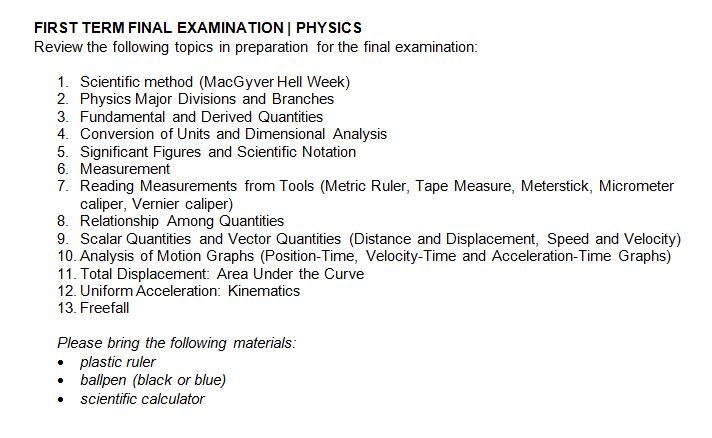
FINAL EXAMINATION COVERAGE
|

| Achievement Test Coverage |
INFORMAL LAB REPORT FORMAT AND GRADING RUBRIC
Use the file below in preparing the informal lab report for Measuring Lab activity.

| informal_lab_report_format.pdf |
IP Powerpoint Presentation Tips and Samples
Some helpful reminders as you make your IP powerpoint presentation
Source: www.iasted.org/conferences/formatting/presentations-tips.ppt
Source: www.iasted.org/conferences/formatting/presentations-tips.ppt
| Powerpoint Presentation Tips |
Sample Powerpoint Presentation 1:
Source: Soriano and Tan. The Effect of Bag Mass on Shoulder and Hip Postural Angles of 4A2012 Students. AHS S2012.
Note: This investigative project won third place (Fourth Year Level) during the AHS IP Congress 2012
Source: Soriano and Tan. The Effect of Bag Mass on Shoulder and Hip Postural Angles of 4A2012 Students. AHS S2012.
Note: This investigative project won third place (Fourth Year Level) during the AHS IP Congress 2012
| 4S IP 2012 |
Sample Powerpoint Presentation 2:
Source: Cajucom and Gorospe. A Comparison of the Efficiency of Starch-Ethanol from Maize Kernels and Cellulosic-Ethanol from Corncobs as Biofuels. AHS S2013
Note: This investigative project won first place (Fourth Year Level) during the AHS IP Congress 2013
Source: Cajucom and Gorospe. A Comparison of the Efficiency of Starch-Ethanol from Maize Kernels and Cellulosic-Ethanol from Corncobs as Biofuels. AHS S2013
Note: This investigative project won first place (Fourth Year Level) during the AHS IP Congress 2013
| 4S IP 2013 |
SECOND GRADING PERIOD EXAMINATION
Wednesday, November 21, 2012
|
Coverage:
Graphical Method of Vector addition
Component Method of Vector Addition
Application of Newton’s Laws of Motion
Forces in Equilibrium
Friction Forces
|
Inclined Plane Systems
Projectile Motion
Resources: GLENCOE Physics: Principles and Problems (Chapters 4, 5 and 6) www.physicsclassroom.com http://ahsphysics.weebly.com Things to Bring: Ballpen (blue or black) Scientific Calculator Do your best. Good luck. |
Sample Review of Related Literature
This Review of Related Literature was written for the research on the effect of the mass of the bag carried by senior students on their posture.
"The review of related literature will focus on the identification of the average load-bearing capacities of individuals, ideal posture, health problems which arise from excessive weight loads and the relationship between posture and muscular injury. The review will not include the differences between males and females and musculoskeletal problems which are not developed due to carrying heavy loads."
Researchers: Vincent Soriano (4A/S2012) and Miguel Tan (4A/S2012)
"The review of related literature will focus on the identification of the average load-bearing capacities of individuals, ideal posture, health problems which arise from excessive weight loads and the relationship between posture and muscular injury. The review will not include the differences between males and females and musculoskeletal problems which are not developed due to carrying heavy loads."
Researchers: Vincent Soriano (4A/S2012) and Miguel Tan (4A/S2012)
| The Effect of Bag Mass on Shoulder and Hip Postural Angles of 4A2012 Students (RRL) |
Sample Methodology 1 (Construction Type)
The methodology described here is designed for the construction of a rain turbine, a device that will catch rainwater and use the energy of falling water to turn a turbine attached to a generator, thereby producing electrical energy.
Researchers: Kevin Henson (4B/S2012) and Jet Tiglao (4A/S2012)
Researchers: Kevin Henson (4B/S2012) and Jet Tiglao (4A/S2012)
| Construction and Testing of a Rain Turbine (Methodology) |
SCIENCE NEWS
Nothing But Net: The Physics Of Basketball Free Throws
Pay attention, Shaq: Two North Carolina State University engineers have figured out the best way to shoot a free throw -- a frequently underappreciated skill that gets more important as the game clock winds down.
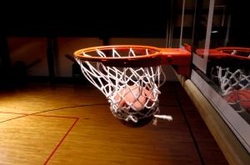
To get a swish rather than a brick, you need the best possible conditions for releasing the basketball from your hand, say Drs. Chau Tran and Larry Silverberg, mechanical and aerospace engineers at NC State and co-authors of a peer-reviewed study. The engineers used hundreds of thousands of three-dimensional computer simulations of basketball free-throw trajectories to arrive at their conclusions. After running the simulations, Tran and Silverberg arrived at a number of major recommendations to improve free-throw shooting.
First, the engineers say that shooters should launch the shot with about three hertz of back spin. That translates to the ball making three complete backspinning revolutions before reaching the hoop. Back spin deadens the ball when it bounces off the rim or backboard, the engineers assert, giving the ball a better chance of settling through the net. Where to aim? Tran and Silverberg say you should aim for the back of the rim, leaving close to 5 centimeters -- about 2 inches -- between the ball and the back of the rim. According to the simulations, aiming for the center of the basket decreases the probabilities of a successful shot by almost 3 percent. The engineers say that the ball should be launched at 52 degrees to the horizontal. If you don't have a protractor in your jersey, that means that the shot should, at the highest point in its arc to the basket, be less than 2 inches below the top of the backboard.
Free-throw shooters should also release the ball as high above the ground as possible, without adversely affecting the consistency of the shot; release the ball so it follows the imaginary line joining the player and the basket; and release the ball with a smooth body motion to get a consistent release speed. "Our recommendations might make even the worst free-throw shooters -- you know who you are, Shaquille O'Neal and Ben Wallace -- break 60 percent from the free-throw line," Silverberg says with tongue firmly in cheek. "A little bit of physics and a lot of practice can make everyone a better shooter from the free-throw line."The engineers used a men's basketball for the study; it is heavier and a bit larger than basketballs used in women's games. They also assumed that the basketball player doing the shooting was 6 feet 6 inches tall, and that he released the ball 6 inches above his head, so the "release height" was set to 7 feet. The free-throw line is 15 feet from the backboard, a cylinder-shaped opening that is 10 feet off the ground. Though it looks smaller, the diameter of a regulation basketball hoop is 18 inches; the diameter of a men's basketball is a bit more than 9 inches.
Source: North Carolina State University (2009, November 8). Nothing But Net: The Physics Of Basketball Free Throws. ScienceDaily. Retrieved November
First, the engineers say that shooters should launch the shot with about three hertz of back spin. That translates to the ball making three complete backspinning revolutions before reaching the hoop. Back spin deadens the ball when it bounces off the rim or backboard, the engineers assert, giving the ball a better chance of settling through the net. Where to aim? Tran and Silverberg say you should aim for the back of the rim, leaving close to 5 centimeters -- about 2 inches -- between the ball and the back of the rim. According to the simulations, aiming for the center of the basket decreases the probabilities of a successful shot by almost 3 percent. The engineers say that the ball should be launched at 52 degrees to the horizontal. If you don't have a protractor in your jersey, that means that the shot should, at the highest point in its arc to the basket, be less than 2 inches below the top of the backboard.
Free-throw shooters should also release the ball as high above the ground as possible, without adversely affecting the consistency of the shot; release the ball so it follows the imaginary line joining the player and the basket; and release the ball with a smooth body motion to get a consistent release speed. "Our recommendations might make even the worst free-throw shooters -- you know who you are, Shaquille O'Neal and Ben Wallace -- break 60 percent from the free-throw line," Silverberg says with tongue firmly in cheek. "A little bit of physics and a lot of practice can make everyone a better shooter from the free-throw line."The engineers used a men's basketball for the study; it is heavier and a bit larger than basketballs used in women's games. They also assumed that the basketball player doing the shooting was 6 feet 6 inches tall, and that he released the ball 6 inches above his head, so the "release height" was set to 7 feet. The free-throw line is 15 feet from the backboard, a cylinder-shaped opening that is 10 feet off the ground. Though it looks smaller, the diameter of a regulation basketball hoop is 18 inches; the diameter of a men's basketball is a bit more than 9 inches.
Source: North Carolina State University (2009, November 8). Nothing But Net: The Physics Of Basketball Free Throws. ScienceDaily. Retrieved November
What is hydroplaning?Physics Safety Road Tips: Driving on heavy rains? Numerous times that you hear cautions on driving when it rains. Perhaps, you know that the road is slippery but there is more than just a slippery pavement. Have you ever heard of the word hydroplaning or aquaplaning? This condition occurs when a layer of water builds up between the rubber tires of your vehicle and the road surface. When this happens, it results to loss of traction preventing the vehicle from responding to control inputs such as steering, braking or accelerating.
Every vehicle function that changes direction or speed relies on the friction between the tires and the road surface. If water comes between the tires and the road, friction may be reduced to the extent that the tires may slip, and the driver may lose control.The grooves of a rubber tire are designed to disperse water from beneath the tire, providing high friction even in wet conditions. |
Hydroplaning occurs when a tire encounters more water than it can dissipate. Water pressure in front of the wheel forces a wedge of water under the leading edge of the tire, causing it to lift from the road. The tire then skates on a sheet of water with little, if any, direct road contact, and loss of control results. If multiple tires hydroplane, the vehicle may lose directional control and slide until it either collides with an obstacle, or slows enough that one or more tires contact the road again and friction is regained. The risk of hydroplaning increases with the depth of standing water and the sensitivity of a vehicle to that water depth.
|
Welcome Physickers!
Physics is Phun! Congratulations for making it to your senior year! We're glad to warmly welcome our new batch of future physicists for this academic year. As we look forward to discover new ideas and technologies in Physics, we hope to explore this amazing science in almost everything that we enjoy - sporting events, theme parks and many more!
|
|
